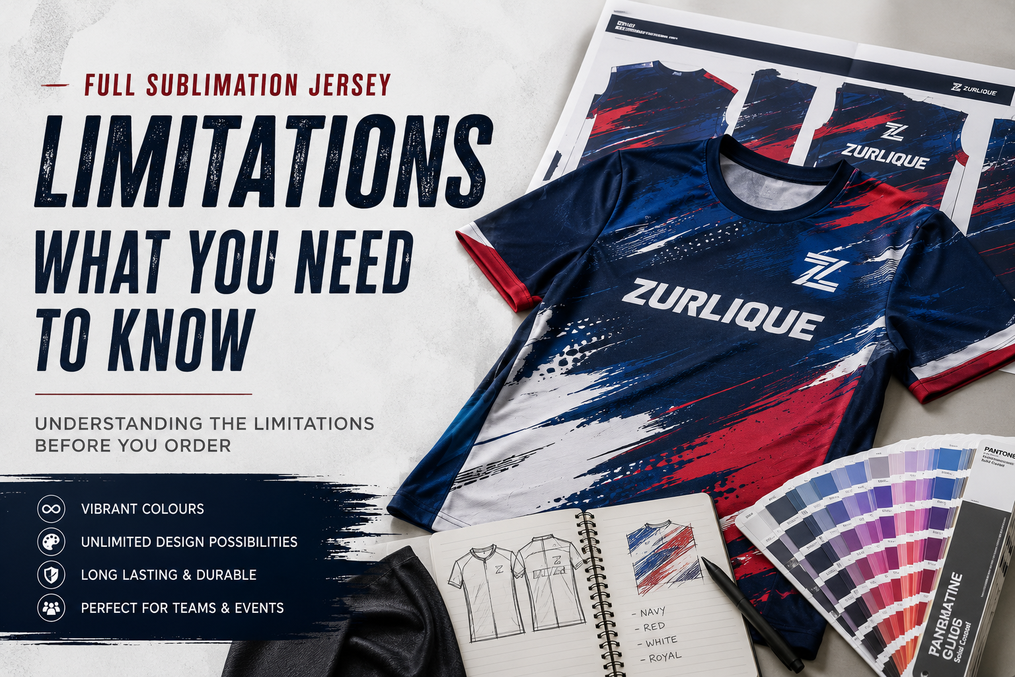
Sublimation printing has become one of the most popular printing methods for custom jerseys, team uniforms and sports apparel. Full sublimation produces vibrant colours, sharp details and permanent prints that will not crack, peel or fade, making it the preferred choice for polyester football jerseys, basketball jerseys, running shirts and many other types of custom apparel.
However, like any printing method, sublimation is not the perfect solution for every project. Depending on the fabric, garment colour, quantity and intended use, other printing methods such as heat transfer printing or embroidery may sometimes be a better choice.
In this article, we'll explore the situations where sublimation printing may not be the right option, helping you understand when sublimation is the best choice and when another printing method may deliver better results for your custom apparel project.
Why Sublimation Printing Works Best on Polyester Fabrics
Sublimation printing works by turning special inks into gas under high heat, allowing the dye to bond permanently with polyester fibres. Unlike surface printing methods, the design becomes part of the fabric itself, producing vibrant colours that will not crack, peel or fade over time.
This is why polyester is the preferred fabric for full sublimation football jerseys, full sublimation basketball jerseys, running shirts and other performance sports apparel. In addition to producing sharp, long-lasting prints, polyester is lightweight, breathable and moisture-wicking, making it an excellent choice for active wear.
Natural fabrics such as cotton do not bond with sublimation dyes in the same way. Although there are specialised coatings and transfer products for certain applications, they generally cannot match the colour vibrancy, durability and wash resistance achieved with sublimation on polyester.
If your project requires cotton garments instead of polyester, other printing methods such as heat transfer printing or screen printing may be more suitable, depending on the garment, artwork and quantity required.
Understanding Pantone Colour Matching in Full Sublimation Printing
Unlike printing onto pre-coloured garments, full sublimation printing starts with plain white polyester fabric. The entire jersey design is first printed onto the fabric, after which the individual panels are cut and sewn together to create the finished garment. This allows full sublimation jerseys to be produced in virtually any colour, including black, navy and other dark shades.
However, if your organisation requires colours to match a specific Pantone code exactly, it is important to understand the limitations of the printing process. Full sublimation uses CMYK process inks rather than spot Pantone inks, which means some colours may not be reproduced with perfect accuracy.
In most cases, the colour difference is minimal and unnoticeable for sports teams, schools and event apparel. However, some Pantone colours, particularly muted shades with lower colour saturation, may be more challenging to reproduce accurately than bright, vibrant colours. Slight colour variations can also occur due to factors such as the fabric, ink, printer calibration and heat transfer process.
If accurate brand colours are critical for your project, it is always advisable to provide your Pantone colour codes and discuss your colour expectations before production. This allows any potential limitations to be identified early and helps achieve the closest possible colour match.
When Heat Transfer Printing Is a Better Choice
Full sublimation is designed for creating completely customised jerseys, where the entire garment is printed with your own colours, patterns and artwork. However, if your design only requires simple customisation, heat transfer printing may be the more suitable option.
Heat transfer printing works well when you only need to add a few elements, such as a company logo, player names, numbers or sponsor logos, onto an existing jersey. Rather than designing and manufacturing an entirely new garment, these graphics can be applied directly to a ready-made jersey.
Unlike full sublimation, where the ink becomes part of the fabric, heat transfer graphics sit slightly above the garment surface. This creates a subtle three-dimensional effect that can make logos, names and numbers appear sharper and more prominent, making it a popular choice for simpler customisation.
Heat transfer printing is also a practical choice for smaller quantity orders, where producing fully customised sublimation jerseys may not be necessary. Many schools, sports clubs and corporate teams also prefer this option when they want to select from a range of factory-made jerseys and simply personalise them with their own branding. Heat Transfer Football Jerseys
If your project requires complete design freedom with custom colours, patterns and all-over graphics, full sublimation remains the better choice. However, if you only require simple customisation on ready-made jerseys, heat transfer printing is often the more suitable option.
How Long Does It Take to Make a Full Sublimation Jersey?
Unlike heat transfer printing, where graphics are applied onto ready-made garments, full sublimation jerseys are manufactured from scratch. Once the artwork has been approved, the design is printed onto white polyester fabric before each panel is cut, sewn together and inspected for quality. This additional production process naturally requires more time than simply customising an existing jersey.
If you have a fixed event date, tournament or corporate function, it is important to plan your order early and allow sufficient time for artwork approval, production and delivery. Rushing the process may limit your design options or require you to consider alternative printing methods if the required timeline cannot be met.
While full sublimation requires a longer production time, it offers complete design freedom, allowing every part of the jersey to be customised with your own colours, graphics, patterns, names and numbers. For projects where time permits, the additional production time is often worthwhile for a fully customised result.
Can a Full Sublimation Jersey Be Produced from a Photograph or AI-Generated Image?
In many cases, yes. A photograph or AI-generated image can serve as an excellent visual reference for a full sublimation jersey. However, these images are usually not suitable for direct production and often require additional artwork preparation before printing can begin.
Unlike heat transfer printing, full sublimation jerseys are produced from individual garment panels rather than a single flat image. The front, back, sleeves, collar and side panels must all be prepared separately to ensure that patterns, logos and graphics align correctly once the jersey has been cut and sewn together.
In addition, logos and text may need to be recreated as vector artwork to achieve the best print quality. Details that are hidden by folds, body contours or camera angles may also need to be reconstructed manually. As a result, reproducing a jersey from a photograph or AI-generated image often involves professional artwork preparation rather than simply printing the supplied image.
For a more detailed explanation of how AI-generated jersey concepts are prepared for production, read our article on Can AI-Generated Jersey Designs Be Printed?
Can a Full Sublimation Jersey Be Reordered Exactly the Same?
In most cases, yes. If the original production artwork is available, a full sublimation jersey can usually be reproduced with the same design, colours and layout for future orders. This makes it easy for schools, sports clubs and corporate teams to order additional jerseys for new members or replacement uniforms.
However, customers should also understand that minor variations may occur between different production batches. Factors such as fabric batches, printer calibration and production conditions can result in slight differences in colour, even when the same artwork is used. These variations are generally minimal and are considered normal within the textile printing industry.
If the original production artwork is no longer available, the jersey may need to be recreated from photographs, mock-ups or reference images before production can begin. Depending on the complexity of the design, this process may require additional artwork preparation and the reproduced jersey may not be an exact match to the original.
To achieve the most consistent results for future repeat orders, it is always advisable to retain the original production artwork and work with the same supplier whenever possible.
Conclusion
Full sublimation is one of the most versatile and durable printing methods available for custom sports jerseys. It offers complete design freedom, vibrant colours and long-lasting prints that become part of the fabric rather than sitting on the surface.
However, as with any printing method, it is not always the right choice for every project. Factors such as fabric type, production lead time, artwork preparation and the purpose of the garment should all be considered before deciding between full sublimation and other printing methods.
If you're planning custom jerseys for your school, sports club or corporate team in Singapore and are unsure whether full sublimation is the best option, our team will be happy to advise you on the most suitable printing method for your requirements.
Contact Zurlique today for a quotation or professional advice.
Call or WhatsApp: 9774 8888
Email: [email protected]
Write a comment